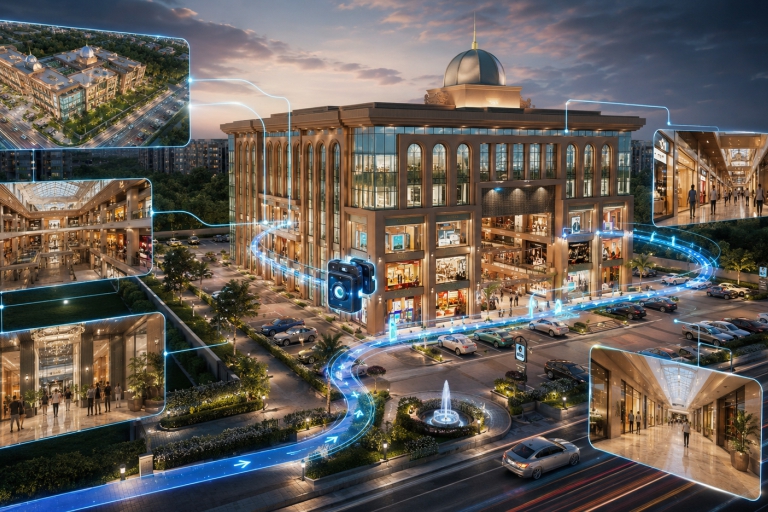
In the compressed financial cycles of the 2026 Indian property market, the gap between architectural conceptualization and consumer capital mobilization has never carried higher stakes. As macro-economic shifts push development priorities toward ultra-premium residential enclaves, expansive commercial IT parks, and integrated luxury townships across tier-1 corridors like Gurgaon, Mumbai, and Bangalore, the baseline requirement for market engagement has evolved past static visual frames.
When positioning high-ticket inventory, real estate firms must provide target audiences with absolute spatial clarity before a single cubic meter of concrete is poured. Capturing capital from sophisticated institutional investors or high-net-worth individuals requires transitioning from static assets into hyper-detailed time-and-motion media. This is where deploying an expertly engineered 3d walkthrough animation real estate India platform becomes a key commercial filter.
For modern asset promoters, a 3d walkthrough animation is no longer a superficial post-production luxury; it is a core operational mechanism to secure early liquidity, compress sales velocity, and de-risk early-phase project financing.
1. Deconstructing the Medium: What is a High-Fidelity 3D Walkthrough Animation?
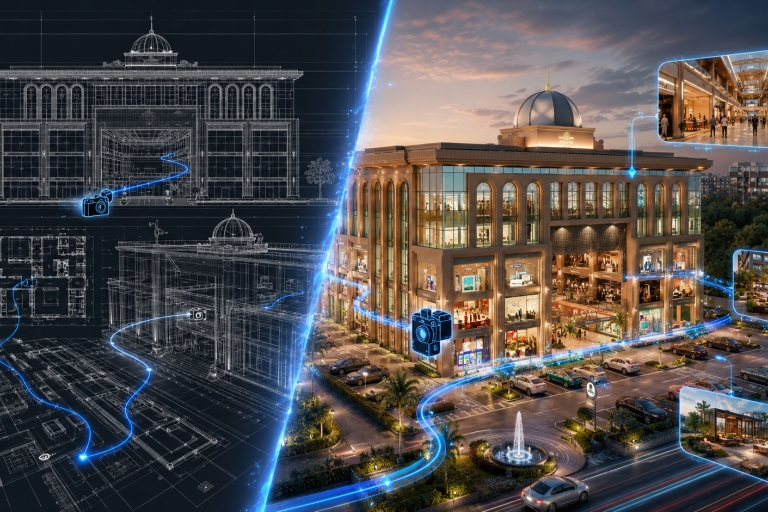
To understand the mechanics of interactive media within the construction ecosystem, developers must differentiate between traditional cinematic loops and true 3d animation walkthrough engineering. At its foundational level, a real estate walkthrough animation india serves as an interactive spatial model. It translates flat, multi-layered CAD drawings, structural layouts, and structural engineering documentation into a seamless, continuous digital narrative.
Unlike still images, which isolate a viewer’s focus onto a single, curated vantage point, an architectural walkthrough animation india establishes context, volume, and depth. It mimics human locomotion and eye movement through a space, calculating spatial transitions with exact focal lengths and camera speeds.
The Evolution of Camera and Spatial Tech in 2026
In the specialized production environments managed by Lucid The Artistry, this asset delivery pipeline branches into specific digital typologies depending on your marketing objectives:
The Fly-Through Animation: An expansive, macro-level aerial perspective that maps out the complete master plan of an integrated township or commercial zone. Typically engineered by importing large-scale site topography and GIS data into advanced rendering pipelines, this methodology uses sweeping, crane-style camera paths to reveal road networks, external infrastructural alignments, clubhouse proximities, and environmental landscaping. It is designed to establish structural scale and geographical prestige.
The Architectural Walkthrough: A micro-level, human-centric progression that explores the interior architecture and layout flows. This technique simulates an exact eye-level journey through main lobbies, high-end common facilities, lift cores, and configured individual apartment layouts. It balances spatial volume with intimate material proximity.
To ensure these assets perform effectively on modern, high-resolution screens, from the expansive digital displays in premium sales pavilions to targeted marketing channels, production teams build these models within a dedicated asset hierarchy:
[2D AutoCAD / BIM Data Ingestion]
│
▼
[High-Polygon 3D Modeling & Asset Populating]│
▼
[Dynamic Lighting, Ray-Tracing & Material Mapping]│
▼
[Camera Path Engineering & Cinematic Motion Setup]│
▼
[High-Performance Server Rendering (FHD to 4K Ultra-HD)]
When these phases are tightly managed, the final asset functions as an immersive, highly scalable representation of unbuilt real estate. It provides a reliable technical baseline for customer acquisition and investor engagements.
2. The Strategic Playbook: Deploying Animations for Maximum Marketing Velocity
The true commercial value of a 3d walkthrough animation, real estate in India is unlocked the moment it is treated as a highly versatile asset across your entire corporate marketing stack. Forcing a premium project to rely on flat 2D plans during high-stakes sales cycles creates consumer hesitation. Instead, real estate promoters use these files across three critical transaction environments.
Phase A: The Pre-Launch Walkthrough & Presales Acceleration
Securing early capital velocity during the pre-launch walkthrough phase requires transforming technical structural planning into an immediate lifestyle narrative. Long before construction machinery arrives on site, developers use high-fidelity animation assets to populate their primary sales engines.
When a prospective buyer enters a marketing pavilion, a standard structural outline cannot communicate the lifestyle return on investment of a premium duplex project. A cinematic, fluid animation allows the sales team to guide the customer through the exact view they will experience from their future double-height balcony, or the sensory finish of the premium stone cladding selected for the primary lobby.
Phase B: Capturing Capital via the Walkthrough for Investor Presentation
When pitching a large-scale real estate venture to institutional funds, private equity firms, or joint-venture partners, clarity on the development’s scope is critical. A dedicated walkthrough for investor presentation strips away visual ambiguity.
By showcasing the structural integration of commercial retail zones with upper-tier office floors, or outlining the spatial distribution of basement parking networks across multiple towers, the asset provides international funds with an objective view of layout efficiency and asset monetization potential.
Phase C: Closing International Sales via the Walkthrough for NRI Buyers
A significant portion of premium and luxury real estate inventory across India’s tier-1 metros is absorbed by non-resident Indian capital. For this demographic, physical site inspections are rare, making digital confidence a prerequisite for financial commitment.
Deploying an authenticated walkthrough for NRI buyers over encrypted digital channels or dedicated virtual sales platforms bridges this distance. By experiencing a continuous, unedited room-by-room digital tour that accurately depicts material selections and structural relationships, international buyers gain the clarity needed to sign contracts and transfer early-stage project deposits remotely.
3. The Economics of Motion: 3D Walkthrough Animation Cost in India
For developers balancing capital allocation across construction cycles, understanding the parameters that govern a 3d walkthrough animation cost in India is essential for realistic production budgeting. In the domestic visualization ecosystem, animation pricing models have moved away from loose project estimates toward structured performance tiers based on resolution, polygon counts, asset customization, and scene complexity.
Quality Classification | Technical Infrastructure | Typical Cost Range (Per Minute of Output) | Ideal Deployment Channel |
Grade A: Hyper-Realistic / Cinematic | Full ray-tracing, custom asset creation, advanced material lighting, 60fps | ₹1,50,000 – ₹4,00,000+ | Luxury penthouses, mega-townships, premium experiential center screens |
Grade B: Standard Commercial | Global illumination engines, mixed library assets, optimized texturing, 30fps | ₹60,000 – ₹1,20,000 | Mid-tier residential projects, standard commercial properties, and web portals |
Grade C: Basic Schematic | Simple 3D block models over layout plans, ambient lighting, and basic material coloring | ₹25,000 – ₹50,000 | Internal engineering reviews, basic structural validation, and local approvals |
Primary Drivers of Animation Production Cost
To accurately plan project expenditures, developers must monitor four key cost drivers that directly influence the required studio hours and compute resources:
Resolution Demands (1080p Full HD vs. 4K Walkthrough): Processing frames for a 4k walkthrough requires a four-fold increase in pixel calculation over standard Full HD. This directly escalates the required time on high-performance render farms and scales the baseline cost up by 15% to 25%.
Scene Complexity and Asset Customization: Utilizing standard, pre-built models for standard fixtures keeps overhead controlled. However, if a developer requires the animation to showcase a specific, high-end Italian marble layout, custom-manufactured modular kitchen systems, or bespoke lighting designs, specialized modeling hours will reflect in the total budget.
Environmental and Atmospheric Complexity: Simulating a uniform daytime scene with fixed lighting paths requires standard computational overhead. In contrast, crafting multi-layered transitions, such as moving from a vibrant midday golden hour down to dusk, or tracking real-time shadow movements across an outdoor swimming pool, requires custom lighting calculations that extend production timelines.
Total Video Runtime and Camera Track Density: Because animation cost is tied closely to final rendering frame counts, an extended five-minute property showcase requires significantly more compute resources than a highly focused 60-second social media preview.
4. The Engineering Blueprint: Anatomy of an Asset Pipeline
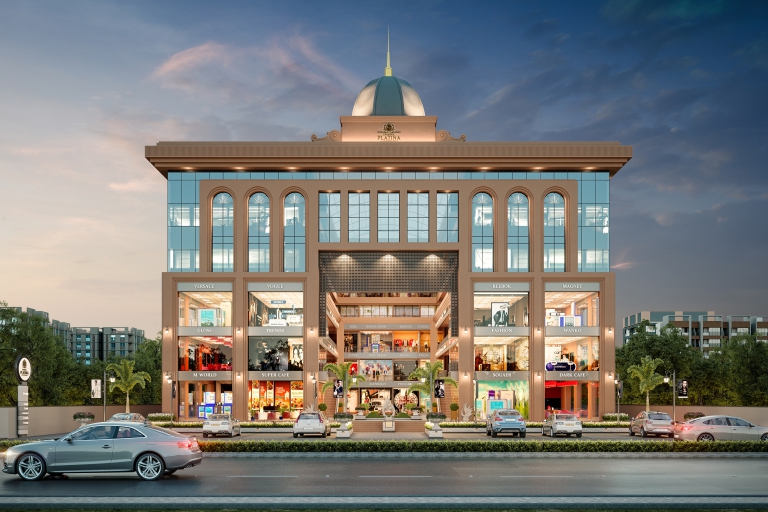
To successfully execute an asset of this scale without running into budget extensions or delivery delays, developers must understand the technical phases that turn architectural data into a high-impact real estate animation video. At Lucid The Artistry, this process is structured with rigorous quality gates to ensure the digital output matches your actual procurement specifications.
Step 1: CAD Ingestion and Spatial Verification
The pipeline begins by absorbing the architect’s technical database, including native AutoCAD files, structural elevations, and detailed section plans. The visualization team rebuilds this information into a 1:1 scale three-dimensional wireframe, validating that structural dimensions perfectly mirror the engineering intent.
Step 2: Camera Trajectory Mapping & Animatic Sign-off
Before rendering detailed surfaces, the team maps out the camera’s path through the layout. This stage produces a raw, untextured grayscale video called an animatic. It allows the developer to audit camera speeds, viewing angles, and the sequence of spatial transitions before committing major computational resources to the final render.
Step 3: Material Texturing, Asset Populating, and Lighting Calibration
Once the track configuration is locked, artists apply digital shaders to every surface to mirror real-world textures. The team models the specific properties of contemporary finishes, including the precise reflection indexes of structural curtain walls, the subtle grain of wooden deckings, and the tactile depth of exterior facade panels.
Step 4: High-Performance Render Farm Processing
The finalized, data-heavy scene is sent to high-performance rendering arrays. Here, advanced software calculates light bounces, spatial occlusion, and environmental reflections frame by frame. For a premium project, thousands of individual frames are compiled sequentially to produce a fluid, cinematic experience.
Step 5: Post-Production, Color Grading, and Delivery
The raw rendered files pass through a dedicated editing suite for color grading, atmospheric enhancements, and synchronization with localized soundscapes or corporate narration. The final, polished asset is then delivered across optimized formats, ready for immediate deployment on web, mobile, and outdoor marketing networks.
5. Maximizing Your Return on Visual Capital: Multi-Channel Deployment
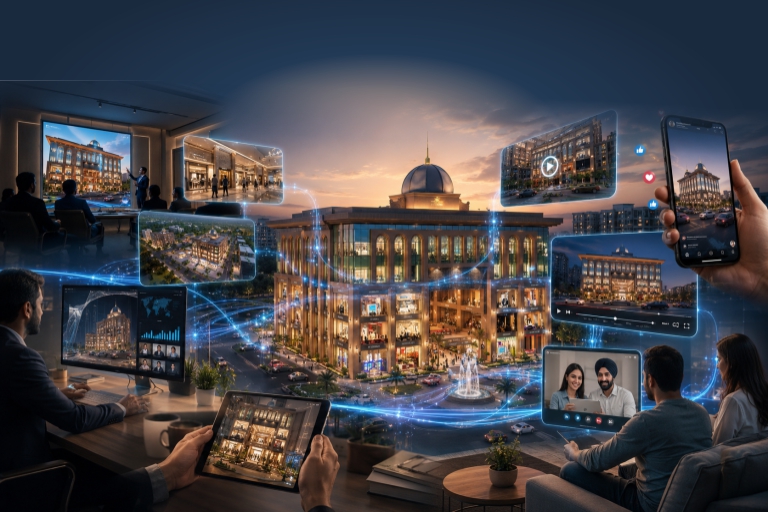
Investing in a premium property tour video delivers its highest return when the asset is consistently used across multiple touchpoints to engage different customer profiles. Relying on a single presentation format limits your reach. Instead, developers should optimize and distribute their animation through a clear multi-channel strategy.
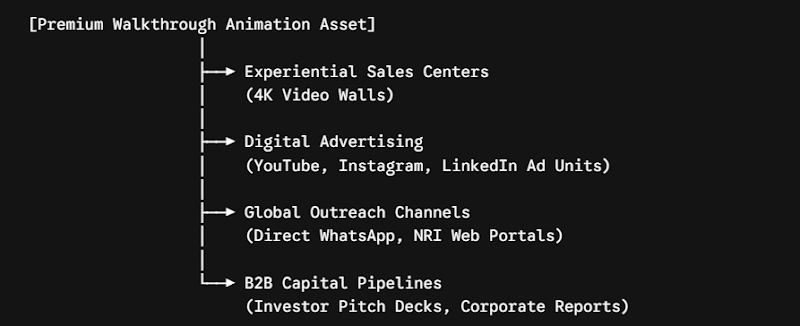
The focal point of your on-site sales engine should be a dedicated display environment. Projecting a clean 4k walkthrough onto expansive, seamless LED video walls or integrated theatre screens creates an engaging focal point for visiting buyers. It provides them with an immersive view of the project’s scale and design details before they step near the active construction site.
2. High-Performance Digital Ad Units
For digital outreach campaigns across platforms like YouTube, Instagram, and LinkedIn, long-form content can be edited into punchy, high-impact clips. A 15-to-30-second teaser focused on a dramatic fly-through view or a signature infinity pool transition helps capture attention online, driving higher click-through rates to your project landing page.
3. Direct Sales outreach via WhatsApp and Mobile Web Portals
In the domestic Indian real estate market, direct messaging channels like WhatsApp are vital for sales communication. By compressing your primary video into lightweight, mobile-optimised file formats, sales teams can send clean property previews directly to prospective leads. This puts a highly polished representation of your project directly into the buyer’s hands, encouraging faster follow-up discussions.
Real-World Insights: Avoiding Common Pitfalls in Animation Production
Pitfall 1: Choppy or Uncalibrated Camera Movement
Cheaply made animations frequently ruin the viewer’s experience with sudden, jarring camera movements. Flying through a room at breakneck speeds or relying on overly wide, warped lens angles breaks spatial awareness entirely. Experienced creative teams prevent this by pacing the virtual camera to match a natural human stride and using realistic focal lengths. This keeps the viewing experience natural, comfortable, and grounded.
Pitfall 2: Guessing Material Specs Instead of Matching Procurement
When a visualization crew works with generic, off-the-shelf textures, the final video shows finishes that rarely match the actual materials waiting at the construction site. This visual disconnect is a huge operational gamble, often leading to intense buyer complaints and legal headaches under RERA at handover. Dedicated studios eliminate this risk by demanding real material samples, exact manufacturer product codes, and specification sheets so that every virtual grain and reflection mirrors reality.
Pitfall 3: Skipping Structured Milestone Sign-offs
Builders often get hit with surprise bills because they request major structural changes far too late in the production cycle. If you tweak the building’s shape after the rendering farm has already started cooking the light maps and frames, the studio has to wipe the slate clean and start over, which destroys both timelines and budgets. Establishing clear check-ins—locking the bare-bones wireframe and camera paths in the early animatic stage before hitting the final render button—keeps the entire schedule predictable.
What Developers Ask About 3D Walkthrough Animations
Q: What is the primary difference between a 3D fly-through animation and an architectural walkthrough?
A: Think of a fly-through as the big-picture view. It relies on high, sweeping aerial cameras to map out the overall master plan, neighbourhood connectivity, and landscaping layout of a massive development. A walkthrough is the opposite, it is a human-scale journey at ground level, travelling room by room through specific apartment layouts or main lobbies to highlight interior finishes, textures, and spatial flow.
Q: Why do 3D walkthrough animation costs for Indian structures vary so significantly between agencies?
A: The massive price gap comes down to computing power, rendering engines, and manual detail. Low-cost shops throw together flat, basic block models with standard lighting that look like video games from a decade ago. Premium studios invest heavily in advanced ray-tracing systems, model custom assets from scratch, and match physical materials exactly. This creates a cinematic product that handles huge screen projection and keeps your legal presentation risks low.
Q: How long does it take a professional studio to deliver a completed 2-minute 4K walkthrough?
A: Expect a top-tier project to take anywhere from 25 to 45 business days, depending on how complex the architecture is. That time is eaten up by importing data, building the digital layouts, mapping camera tracks, tweaking custom textures, and letting heavy-duty render farms calculate the millions of pixels needed for each individual frame.
Q: Can a walkthrough animation video be updated if our team changes material finishes or layout designs mid-way through construction?
A: Yes, but the impact on your wallet and calendar depends entirely on what you change. Cosmetic adjustments, like swapping a tile texture or changing a paint color, are fairly quick fixes inside existing project files. True structural overhauls, like moving walls, changing window shapes, or altering room sizes, force the design team to rebuild the underlying 3D geometry. Making these core geometric alterations forces the production team to recalculate every shadow map and rerun the render farm processing loops from scratch.
Securing Your Pre-Sales Pipeline with High-Performance Visualization
As competition across the Indian property market sharpens, a project’s launch velocity depends heavily on clean, transparent customer interaction. When a developer moves into high-end luxury residential builds or large commercial properties, relying on basic sketches or low-grade visuals creates immediate friction in your marketing machine.
Breaking through market noise and establishing immediate buyer trust requires partnering with a specialized visualization studio that understands how to translate raw structural data into commercial confidence. Working with a studio that has the hardware and technical skill to deliver flawless architectural animations allows your brand to present unbuilt spaces clearly, secure institutional investors faster, and maintain a steady stream of early sales across all channels.
Real value in modern property marketing is unlocked when a promoter stops viewing digital media as decorative artwork. Deploying a structured 3D walkthrough animation real estate India strategy transforms creative files into an analytical, high-performance sales tool that secures early project liquidity and drives predictable conversion velocity from day one.