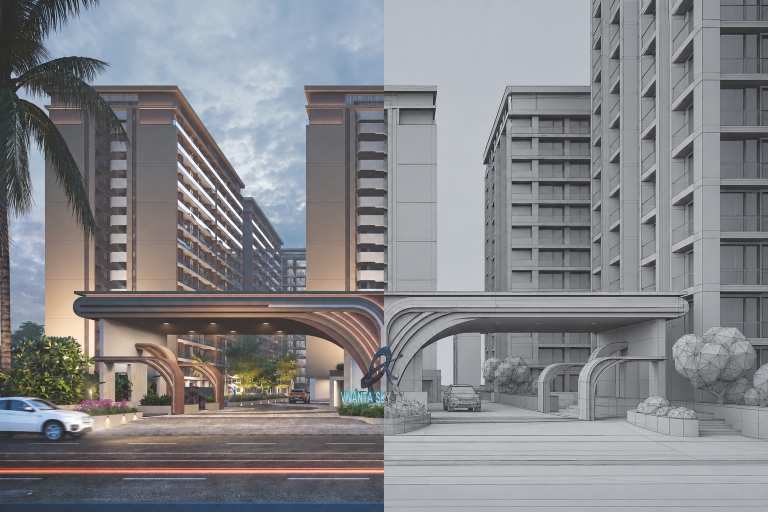
Real estate decisions in India often begin before construction even starts. Most buyers encounter a project online before they experience it in person. The clarity of that first impression often influences the rest of the decision process
Builders in India are switching from 2D drawings to 3D elevation design because it removes confusion, improves buyer understanding, and increases pre-launch sales. 3D visuals show the final outcome clearly, helping buyers trust the project faster. In competitive markets like Gujarat, this shift is directly linked to faster decision-making and stronger real estate marketing performance.
According to the National Association of Realtors (2024), listings with visual content receive 118% more engagement. Attention is no longer the challenge. Clarity is.
Limitations of 2D Drawings in Real Buyer Decisions
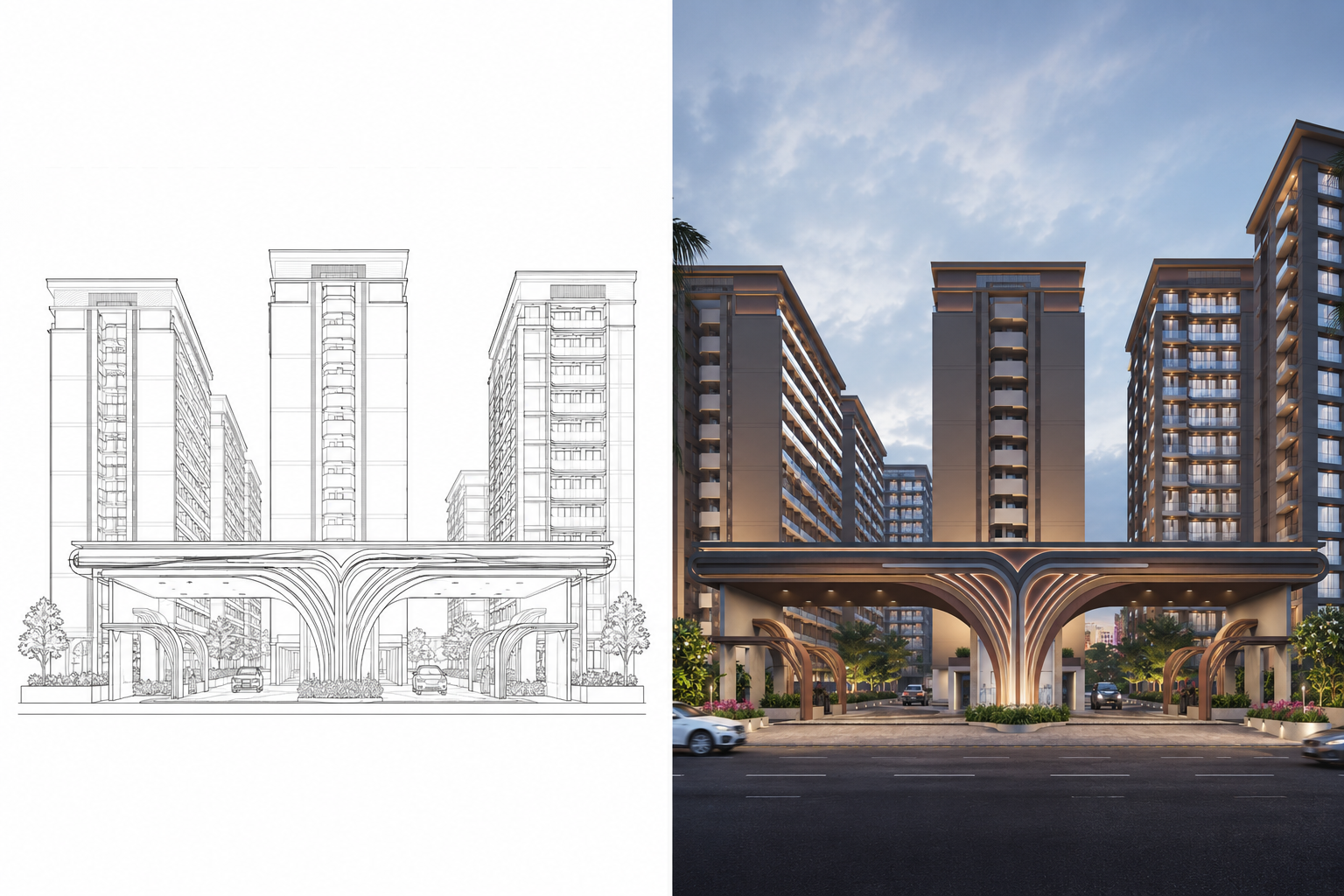
A2D plan is easy to understand for people familiar with technical drawings, but many buyers find it harder to visualise the actual space from it.
Lines and measurements require interpretation. Depth, elevation, and real-world scale are not immediately obvious. Buyers try to imagine the finished project, but that process is often incomplete or incorrect.
This creates a quiet problem. Interest does not disappear, but it weakens. Buyers delay decisions or move toward options that feel easier to understand.
In India, decisions rarely happen alone. Family members are involved, and not everyone interprets drawings the same way. Agreement becomes difficult even when the project is strong.
Buyers don’t reject projects, they reject what they fail to understand visually.
What is 3D Elevation Design and Why It Changes Perception
3D elevation design shows the exterior of a building as it will appear after completion, including materials, lighting, and surroundings.
The difference is immediate. Buyers no longer need to interpret anything. The building is visible in a realistic form.
Glass reflects light. Shadows fall naturally. Proportions feel accurate.
According to Matterport (2023), 3D visual experiences can increase buyer interest by up to 87%. The reason is straightforward. People trust what they can see clearly.
This is also where emotional connection begins. A realistic elevation does more than inform. It helps buyers imagine ownership.
Why Builders Across India Are Adopting 3D Visualization
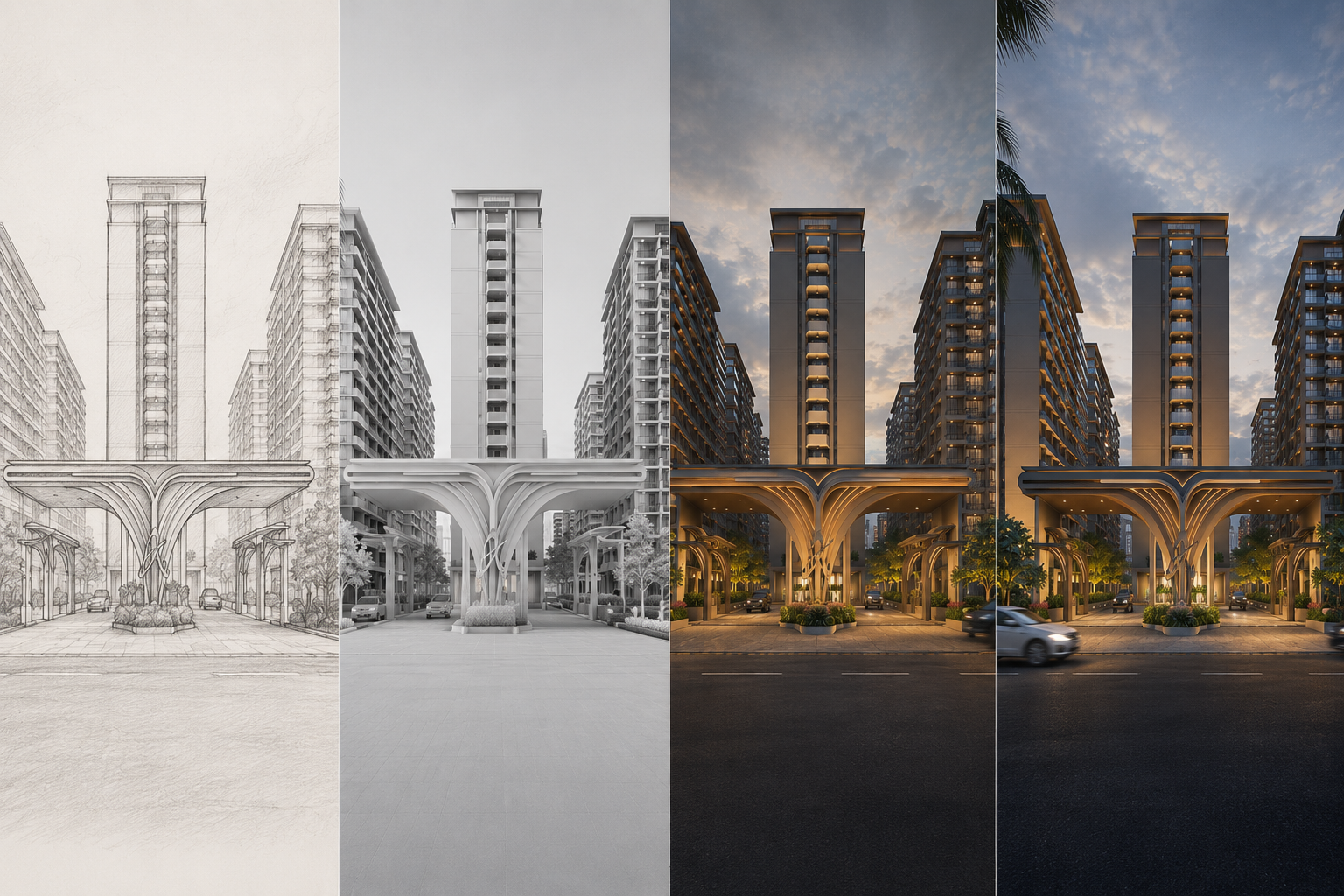
Pre-launch sales play a major role in Indian real estate. JLL India (2023) estimates that 30 to 40% of inventory is sold before completion.
At that stage, nothing exists physically. Buyers depend entirely on how the project is presented.
3D visualization reduces the gap between promise and perception. Builders can show what they are offering instead of explaining it.
In our experience, projects using only 2D drawings tend to receive repeated basic questions. Layout clarity, facade appearance, and scale remain unclear. Once 3D visuals are introduced, conversations shift toward pricing, unit selection, and timelines.
The sales process becomes more focused because understanding comes earlier.
Role of 3D Rendering in Real Estate Marketing
Most buyers begin their property search online. NAR Global Housing Insights (2024) states that over 90% of buyers follow this pattern.
Visuals act as the first site visit.
A static plan offers limited engagement. A 3D walkthrough allows buyers to explore the space, understand movement, and evaluate usability. This is especially useful for buyers who are not physically present in the city.
In pre-launch real estate, clarity sells faster than pricing.
At Lucid The Artistry, the approach to 3D rendering services is built around this idea. The focus stays on helping buyers understand the project quickly, not just making visuals look appealing.
Gujarat and Ahmedabad Market Insights
Cities like Ahmedabad and Surat have seen faster adoption of 3D elevation design across projects of different scales.
Buyers in these markets are practical. Pricing matters, but certainty often matters more. A project that feels complete and believable tends to attract more attention.
A simple comparison explains this shift. Two similar projects launch in the same area. One relies on 2D layouts. The other presents realistic 3D visuals and walkthroughs.
Most initial interest moves toward the second option. Not because of pricing differences, but because it is easier to understand.
This pattern is becoming consistent across local markets.
Impact on Sales and Buyer Confidence
Buyer hesitation is often linked to uncertainty, not cost. PropTech India Insights (2024) highlights that lack of clarity is a major reason for delayed decisions.
3D rendering services address this directly.
Buyers who clearly understand a project tend to:
- Shortlist faster
- Involve family earlier
- Move toward booking with fewer follow-ups
One important limitation needs to be acknowledged. 3D visualization does not compensate for weak project fundamentals. It strengthens communication, but it cannot fix planning issues or unrealistic pricing.
It works best when the underlying product is already strong.
Integration with 3D Rendering and Walkthrough Services
3D elevation design is one part of a larger system. Walkthroughs and detailed rendering complete the experience.
A still image shows appearance. A walkthrough shows movement and space usage.
This becomes particularly relevant in commercial building 3D rendering India projects where buyers evaluate functionality along with design.
Developers who integrate these tools early in the marketing process often see smoother launches. The project story remains consistent across all channels.
Common Mistakes Builders Still Make
Adoption of 3D visualization is increasing, but execution varies.
Some common mistakes include:
- Visuals that look unrealistic compared to actual construction
- Generic designs that do not reflect project identity
- Poor lighting or texture quality that reduces credibility
- Using 3D too late in the marketing cycle
Another issue is treating rendering as decoration rather than communication. When visuals are created without understanding buyer concerns, they may look impressive but fail to answer important questions.
Choosing the Right 3D Rendering Agency
Selecting a 3D rendering agency requires more than reviewing a portfolio.
The right partner understands:
- Buyer expectations in your segment
- How much detail is necessary
- Where to simplify for clarity
Lucid The Artistry focuses on aligning visuals with how buyers actually evaluate projects. The output is designed to support decision-making, not just presentation.
This difference becomes visible in how quickly conversations move from viewing to serious inquiry.
What most people ask about 3D elevation design
What is the difference between 3D rendering and 3D elevation design?
Most people mix these up. Elevation is just the outside view. Rendering goes wider. Interiors, walkthroughs, everything. In real projects, both usually come together.
What is the usage of 3D walkthrough in real estate?
It’s not just for showing. It’s for feeling the space. Buyers don’t always say it, but they want that clarity. A walkthrough gives it fast.
Is 3D elevation design necessary in India now?
At this point, almost yes. Projects without it still sell, but slower. More questions. More hesitation. That gap is real.
How do you choose a 3D rendering company?
Portfolio matters, but not the most. Look at how they think. Some teams focus on visuals. Better ones focus on understanding. Studios like Lucid The Artistry usually lean that way.
Closing Thought
The move from 2D drawings to 3D elevation design reflects a shift in how trust is built.
Buyers move forward when they can clearly see what they are investing in. Projects that require explanation often lose momentum before serious conversations begin.
In real estate marketing, the speed of understanding often decides the speed of sales.
For upcoming launches, the question is not whether 3D visualization should be used. The real advantage lies in how early it becomes part of the process.